Guide
Professional Range Hood Cleaning and Maintenance
Baffle filters, duct runs and make-up air — how to keep a high-CFM hood over a professional range working, and the faults that follow when it is neglected.
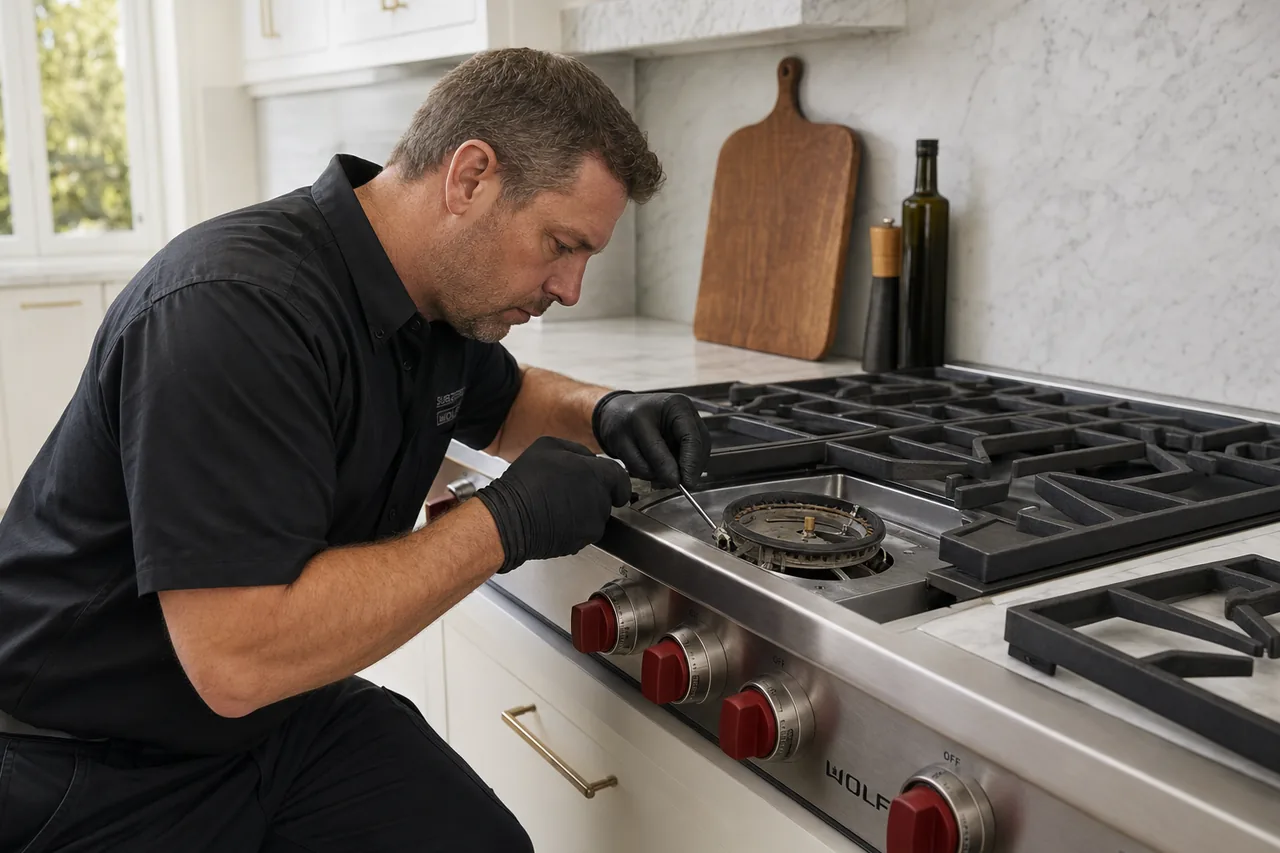
A professional range is only half a system. The other half is hanging above it, and it is the half nobody schedules.
A hood over a 60,000-BTU rangetop is not decoration. It is the thing keeping grease out of your cabinetry, combustion by-products out of your kitchen, and moisture out of the wall cavity. When it stops working properly it rarely announces itself — the first sign is usually that the kitchen smells of last night.
The four-week job: baffle filters
Professional hoods use stainless baffle filters, not mesh. Grease-laden air changes direction through the baffles, the grease condenses on the metal and drains into the channel. That only works while the channels are open.
Pull them monthly. Most go in the dishwasher on a hot cycle — check your model, because a few finishes object. Otherwise a soak in hot water with a degreasing detergent and a brush along the channels.
Put them back the right way round. Baffles have an orientation, the drain channel points down, and a set fitted upside down drains grease onto the rangetop instead of into the trough.
Two habits that halve the work: run the hood before you start cooking, not after the pan is already smoking, and leave it running ten minutes after you finish so the duct clears itself while it is still warm.
The six-month job: everything downstream of the filters
Filters catch most grease, not all. What escapes coats the blower housing, the impeller and the first stretch of duct.
- Blower housing and impeller. An impeller with grease built up on one side goes out of balance and starts to hum, then rumble. Left long enough it kills the motor bearings.
- The damper. Every ducted hood has a backdraft damper. Grease and salt air seize them, and a stuck damper either blocks the airflow or leaves a permanent hole to the outside. Larchmont’s winter wind off the Sound finds that hole immediately, and a cold draught over the range in January is very often a damper stuck open rather than a window problem.
- The termination. Outside, where the duct exits, there is a cap with a flap and often a screen. Check it from the ground with binoculars if you have to. Birds nest in them. Screens that were not specified blind with grease and quietly strangle the airflow.
Make-up air: the thing that actually stops hoods working
This is the failure mode that confuses people most, because nothing is broken.
A high-CFM hood extracts a large volume of air. That air has to be replaced. In a tightly built or well-renovated house there is no easy path for it, so the hood starves — it runs at full speed and moves almost nothing, and in the worst case it pulls air backwards down another flue.
The symptom is a hood that used to work and now does not, with no change to the hood itself. Often it follows new windows, air sealing, or a renovation. Crack a window near the kitchen and test: if performance returns immediately, you have a make-up air problem, not a hood problem, and it needs an actual make-up air solution rather than a bigger blower.
Reading the symptoms
Smoke escaping the sides. Undersized capture area, hood mounted too high, or filters blinded.
Noise that has changed. New rumble means impeller imbalance or bearings. A rattle at start and stop is usually the damper.
Lights work, blower does not. Control, switch or motor — the lighting circuit is usually separate, so this narrows it usefully.
Speed control stuck. On electronically controlled hoods this is a board or a touch panel, both serviceable.
Grease dripping onto the range. Filters in upside down, or channels so full they have overflowed.
Why this matters more on the shoreline
Two local factors. Salt air reaches ducts and dampers through the exterior termination, and corrosion on a damper hinge is a genuinely common find in these blocks. And summer humidity means the moisture a hood removes is a larger share of its job than it would be inland — a hood that is underperforming in August in Larchmont shows up as condensation on the cabinet fronts nearest the range.
What we service
Blower motors, impellers, dampers, switches, speed controls, wiring and duct terminations are all repairable. The ductwork itself is the one part worth inspecting rather than assuming — a run installed with too many elbows will never hit its rated CFM no matter what is fitted at either end, and it is better to know that than to keep replacing motors.
The diagnostic is $95, credited toward the repair, and the work carries a 1-year parts and labor warranty.
Call (914) 809-9382 for ventilation service in Larchmont.