Guide
Planning Appliances for a Kitchen Remodel
The appliance decisions that are expensive to change later — ventilation, power, water, clearances and service access — from the people who come back years afterwards to fix them.
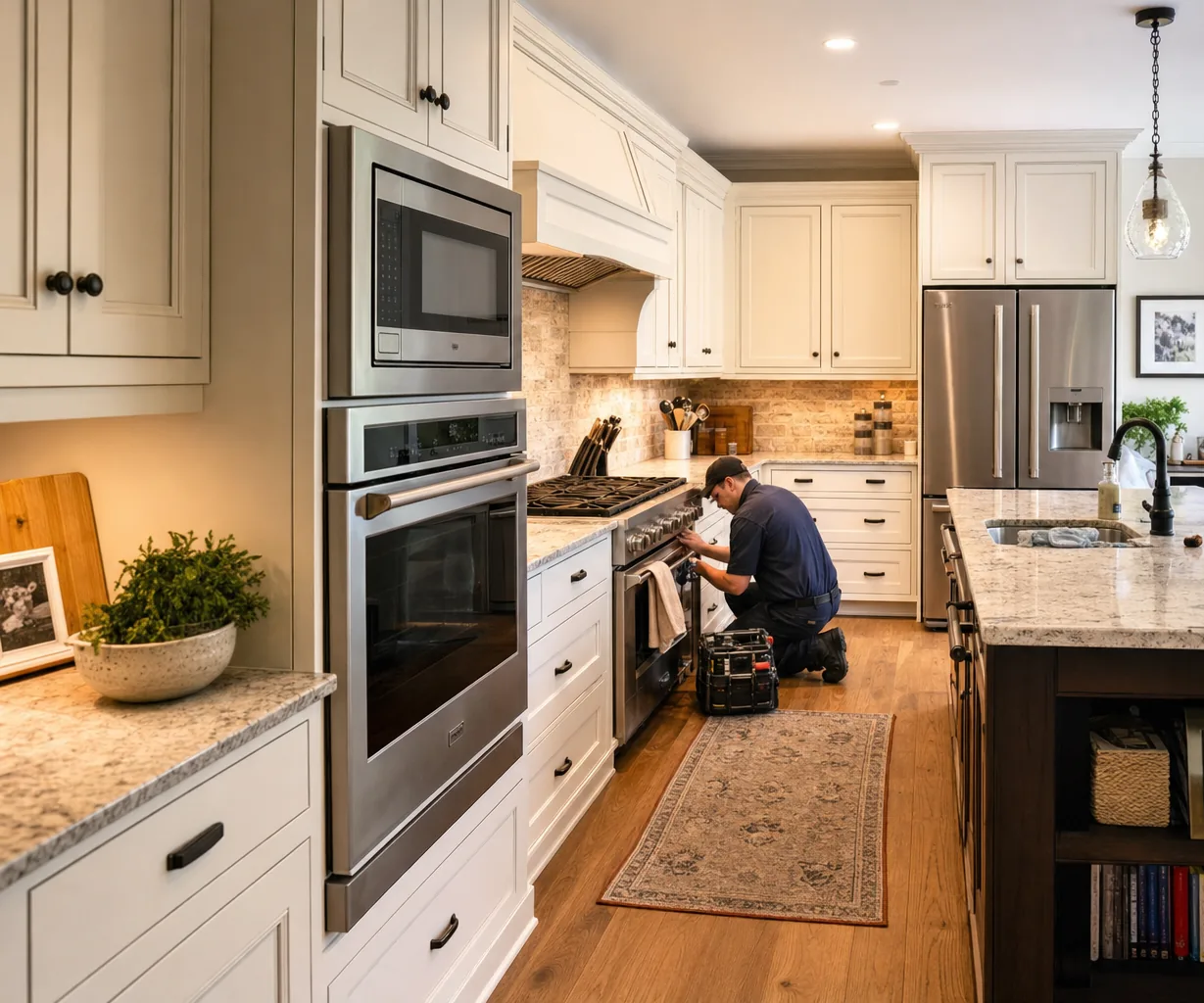
We are not designers and this is not a style guide. We are the people who arrive in year six, pull a panel off, and find out what was decided in week two of a renovation.
What follows is that list: the appliance decisions that are cheap to get right on paper and expensive to change once the cabinetry is in.
Decide the ventilation before you decide the range
This gets done backwards almost every time. The range is chosen because it is beautiful, and the hood is fitted to whatever space is left.
A professional rangetop needs extraction matched to its BTU output, a duct run sized for it, and — the part that gets skipped — a path for replacement air. Make-up air is not optional on a tight house with a high-CFM hood. Retrofitting it after the walls close is the single most disruptive appliance correction we see anyone make.
Settle the hood, the duct route and the make-up air strategy first. Then choose the range that fits what the house can actually ventilate.
Leave service access, or pay for it later
Built-in refrigeration needs its condenser cleaned. That means the grille has to come off, which means it needs clearance, which means the trim above it cannot be fixed in place.
The same logic applies right across the kitchen:
- An undercounter unit boxed in with no way to slide it forward turns a twenty-minute repair into carpentry.
- A dishwasher whose panel was fitted with fasteners that are now behind the adjoining cabinet leg has to be fought out.
- A wine cabinet in a run with no ventilation gap will run warm forever and there is nothing to repair.
Ask your installer one question about every built-in: how does this come out. If nobody has an answer, that appliance will be difficult for its whole life.
Power and water, decided early
Induction needs a real 240V circuit with both legs solid. Half a supply is a cooktop that lights up and never heats, and that fault is diagnosed in the panel, not in the appliance.
Double ovens, steam ovens and warming drawers each want their own circuit. Stacking them onto whatever was already in the wall is how a kitchen ends up tripping on Thanksgiving.
A steam oven needs plumbed water, or a reservoir someone will actually fill. Reservoir models lose their charm by month three.
Ice makers and refrigerators want a proper shutoff you can reach. A valve buried behind a fixed panel means the only way to stop a leak is the main.
Larchmont’s water carries enough mineral that inline filtration on ice makers and steam ovens pays for itself in scale you never have to descale.
Clearances that get missed
Check the door swing of a built-in refrigerator against the island. A 90-degree opening that cannot happen means the crisper drawers cannot come out.
Check that the refrigerator’s cabinet depth matches the run — panel-ready depths differ between manufacturers and between generations of the same manufacturer, and “counter depth” is not a standard.
Check the path from the front door to the kitchen. A 48-inch range will not turn a tight village staircase, and the discovery is usually made on delivery day.
One brand or several?
Both are defensible. A single-brand suite gives you one look, one set of controls and one service relationship. Mixing lets you put the best refrigeration and the best cooking in the same kitchen, which is what most of the serious cooks in this village do — and because Sub-Zero and Wolf come from one company, that particular mix is not really mixing at all.
What matters more than either is parts support for the specific model. A discontinued line is a fine appliance and a harder ownership story in year twelve. Ask your dealer about the model, not the badge.
The coastal note
If the house is within a few blocks of the Sound — Larchmont Manor, Premium Point, anywhere with a water view — salt air is a design input. It loads condenser coils faster, it reaches connections behind panels, and it is hard on exposed stainless.
Two decisions follow. Give every condenser real, easy access, because it will need cleaning quarterly rather than twice a year. And specify a service gap behind built-ins rather than the minimum, so a technician can reach the connections before corrosion reaches them.
Finally: surge protection
Storm-season voltage on the shoreline is not gentle, and modern built-ins are electronics-first. A control board is one of the more expensive things in a premium appliance and one of the more preventable failures. Whole-house surge protection is a fraction of what a single board costs.
If you are mid-plan and want a second opinion on access, ventilation or supply before the cabinetry is ordered, call (914) 809-9382. It is a far cheaper conversation now than in year six.