Guide
Wine Cooler Temperature Problems: A Diagnosis Guide
A fault-tree for a wine cabinet that runs warm, runs cold or swings — how to read the pattern before a technician arrives, and which faults threaten the bottles.
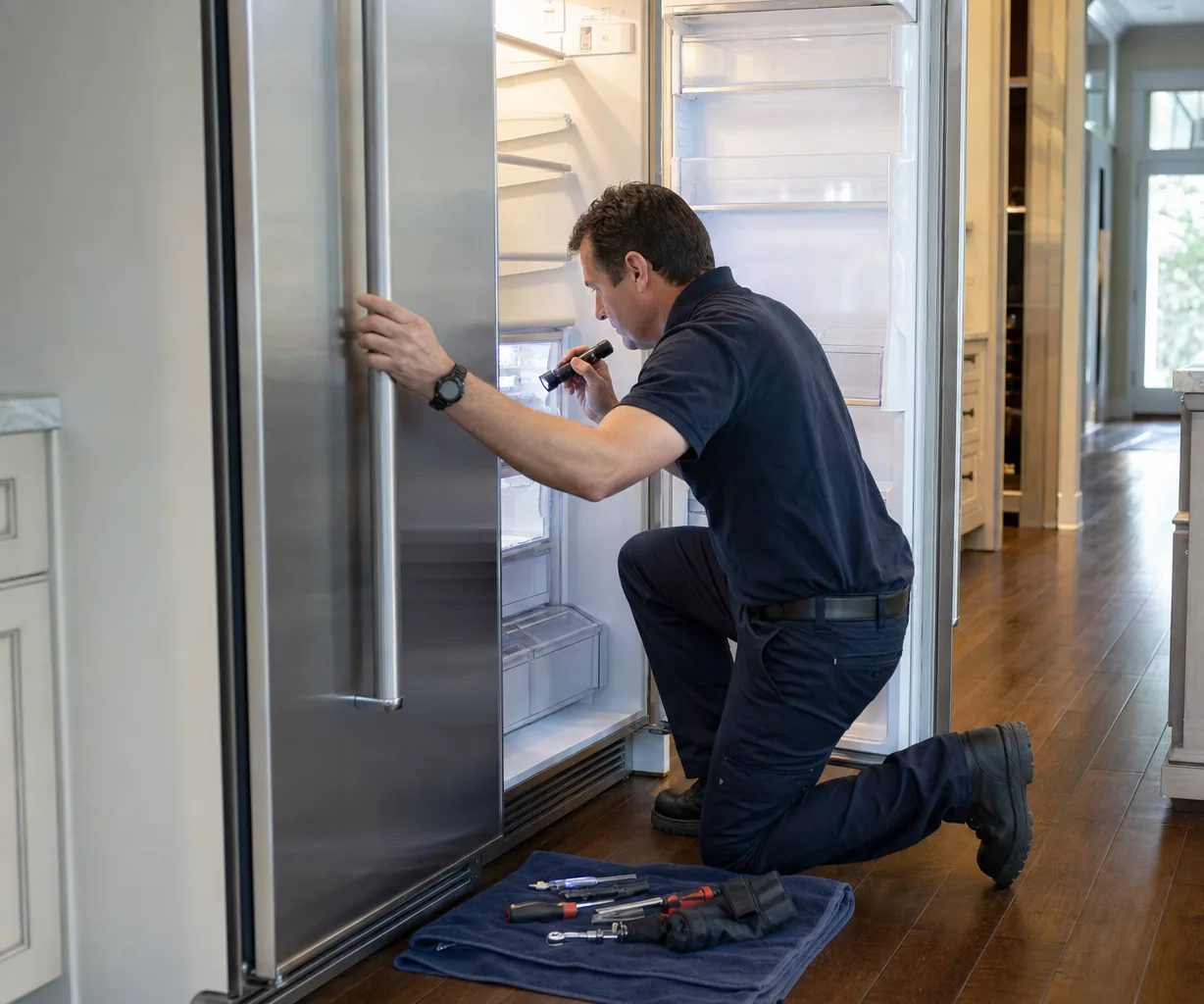
This is a diagnosis guide, not a storage guide. The question it answers is narrow: your wine cabinet is not holding the number on its display, and you want to know what that means before someone opens it up.
Step zero — verify the reading
Cabinet displays report the sensor’s opinion, not the bottle’s temperature. Put an independent thermometer on a shelf, mid-cabinet, and leave it four hours with the door shut.
Three outcomes, and they are genuinely different problems:
- Thermometer agrees with the display, and both are wrong — a refrigeration or airflow fault.
- Thermometer disagrees with the display — a sensor or calibration fault. The machine is cooling correctly to a wrong target.
- Thermometer wanders while the display sits still — the worst of the three for wine, and the hardest to catch.
Branch A — running warm
Start outside the cabinet. Ambient matters more on wine units than on refrigerators, because many are built to a narrower climate class. A cabinet in an unconditioned space, or tucked into a cabinetry run with its vent blocked, will simply lose the fight in August.
Then, in order:
- The condenser. Same story as any refrigeration in this village — dust and salt air near the Sound blanket the coil fast. Clean it before assuming anything worse.
- The gasket. A door that does not seal on a glass-fronted cabinet leaks continuously, and a UV-glass door is heavy enough to drag its hinges out of alignment over years.
- Load and habit. A cabinet opened repeatedly through an evening never recovers. If warm only ever follows a dinner party, that is not a fault.
- The evaporator fan. If the cabinet is cold at the coil and warm at the far end, air is not moving.
- The sealed system. Last, and only by instrument.
Branch B — running cold
Less common and more urgent, because wine that freezes is wine that is finished — the cork pushes and the seal is gone.
The usual causes are a sensor reading high (so the machine over-cools to satisfy it), a control board stuck calling for cooling, or, on a dual-zone cabinet, a damper between zones that has failed open. Bottles nearest the cold-air outlet freeze first, which is a useful clue: uniform cold points at control, localised cold points at airflow.
Move the bottles nearest the outlet while you wait. That is a real, useful action, not a stalling tactic.
Branch C — swinging
Temperature swing is what actually ages a collection badly, and it is the fault most likely to be dismissed as “it’s fine, it reads 55”.
Look for short cycling — a compressor starting and stopping every few minutes rather than running in long, settled cycles. Causes include a failing start relay, a sensor with an intermittent connection, and a cabinet so lightly loaded that there is no thermal mass to steady it. That last one is real: a nearly empty cabinet swings much more than a full one, and the cheapest fix in this entire guide is filling it.
Location is a factor too. A cabinet beside a dishwasher or an oven takes a heat pulse every time its neighbour runs.
The dual-zone footnote
Two zones mean two setpoints, sometimes two sensors and a shared or split refrigeration path. A fault in one zone and not the other narrows the field immediately, so report it that way. “The reds are fine, the whites are at 60” is a far more useful sentence than “it is not cooling”.
The Larchmont particulars
Two things recur in cabinets here. Salt air off the Sound loads condensers faster than the manuals assume — quarterly cleaning is a reasonable habit within a few blocks of the water. And a good number of cabinets in the village are installed in below-grade rooms where summer humidity is high; condensation on the inside of the glass in July is usually a gasket and humidity story rather than a refrigeration fault.
What repair looks like
Wine cooler and cellar repairs generally run $300 to $900 including parts and labour — fans, sensors, gaskets, thermostats and control boards are all serviceable. Sealed-system work runs higher and is worth a straight conversation about the cabinet’s age before it is quoted. The $95 diagnostic is credited toward the repair, with a 1-year parts and labor warranty.
If the collection is valuable and the cabinet is unstable, move the bottles somewhere dark and steady first. The cabinet can wait; a swing through the high sixties cannot be undone.
Call (914) 809-9382 with your independent thermometer reading and which branch above you landed in.